The Fight for Life in Ecuador’s Páramo
In the highest parts of the Ecuadorian Andes, there is a place where they say “water is born”. This is referring to the páramo, a vital high-altitude wetland that acts as a natural water plant, generating up to 19 cubic meters of water every second, enough to sustain thousands of families, individuals, and their crops. Yet, for the indigenous communities living alongside this natural reservoir, access to clean water is not a guaranteed right; it is a daily struggle created by historical exclusion and modern environmental degradation. At MEDLIFE, we believe that understanding these complex local systems is the first step toward breaking these social and political barriers to create lasting, positive change.


The Legacy of the 1964 Agrarian Reform and Modern Water Inequality
The roots of the current water crisis stretch back to the failed 1964 agrarian reform. While the government military’s original goal was an equitable redistribution of land, the reality left the indigenous peoples in a deeply unjust position. Families were forced onto small, low-productivity plots at high altitudes, often only about 400-500 square meters. Meanwhile, fertile, productive lands remained under the possession of wealthy landowners and industrial corporations.
This historical imbalance has birthed a system of profound water inequality for decades upon decades. Today, while rural communities sacrifice their livelihoods to protect high-altitude water sources, they are allocated only 12% of the water produced. The remaining 80% to 88% is controlled by the state for industrial uses, including large-scale hydroelectric systems, mining, and floriculture. For communities like San Martín Alto, this means that even though their ancestral lands produce life-giving water, consistent access to clean water for low-income people remains frustratingly out of reach.
The Boiling Point: Climate Change in Ecuador
The fragility of this mountain-top ecosystem is becoming further threatened by the escalating impact of climate change in Ecuador. Statistical studies in the region have revealed a significant temperature increase of 2 degrees celcius in the páramo. Where temperatures once ranged safely between 4 degrees celcius and 12 degrees celcius, they now frequently spike to as high as 14 degrees, disrupting the delicate hydrological cycle.
This warming trend, combined with local pollution and human-made emissions, is a direct threat to the thick vegetation responsible for capturing cloud moisture and storing greenhouse gases in the páramo. Without these natural “water sponges,” the primary source of the region’s drinking water could vanish. For indigenous families already marginalized by the state, these environmental shifts make the pursuit of access to clean water even more precarious.
Grassroots Solutions & MEDLIFE’s Role
Despite these systemic barriers, local leaders are finding divergent solutions to protect their future. Organizations like the Chubamba and Yasapán Cooperative have transitioned from traditional cattle ranching to dedicated conservation. By declaring their territory a Wildlife Refuge, they are shielding over 5,000 hectares of land from mining exploitation to guarantee future water recharge.
By embracing agroecological practices and a central philosophy of “respect for life,” these communities are proving that productivity can coexist with sustainability. Whether it is building greenhouses to grow high-value crops like strawberries on small, dry plots or collaborating with universities for scientific research, the goal remains clear: to ensure that the water born in the mountains reaches the people who need it most.
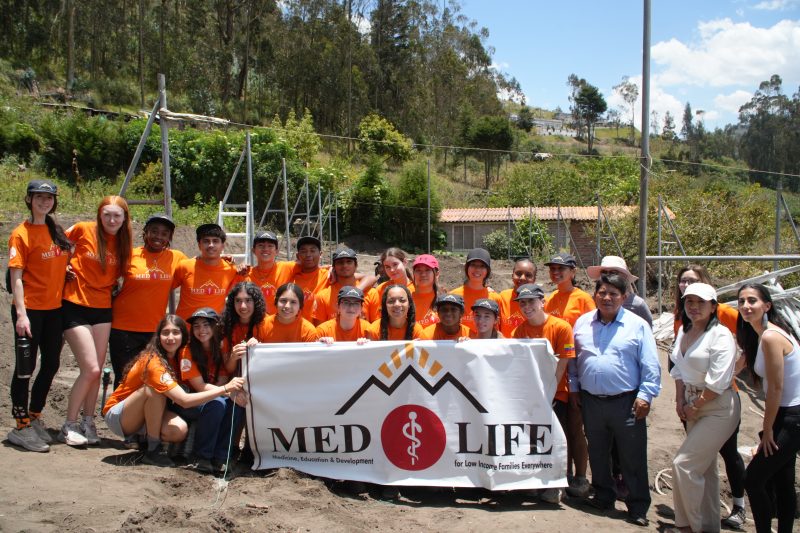
At MEDLIFE, our long-term vision is to support these local initiatives through healthcare outreach, community development, water access projects, collaborations with local municipalities and leaders, as well as student field education. Our approach is focused on addressing the root causes of poverty and environmental health over decades, not just days. Without an understanding of the full story, it is difficult to present solutions.
Only through collective action and industrial accountability can we protect the páramo and the millions of lives that depend on its flow.
Interested in how you can work alongside communities in Ecuador facing water insecurity and lack of access to healthcare, education, and infrastructure? Consider joining a MEDLIFE Service Learning Trip! To get started today, fill out the interest form below or download our brochure.